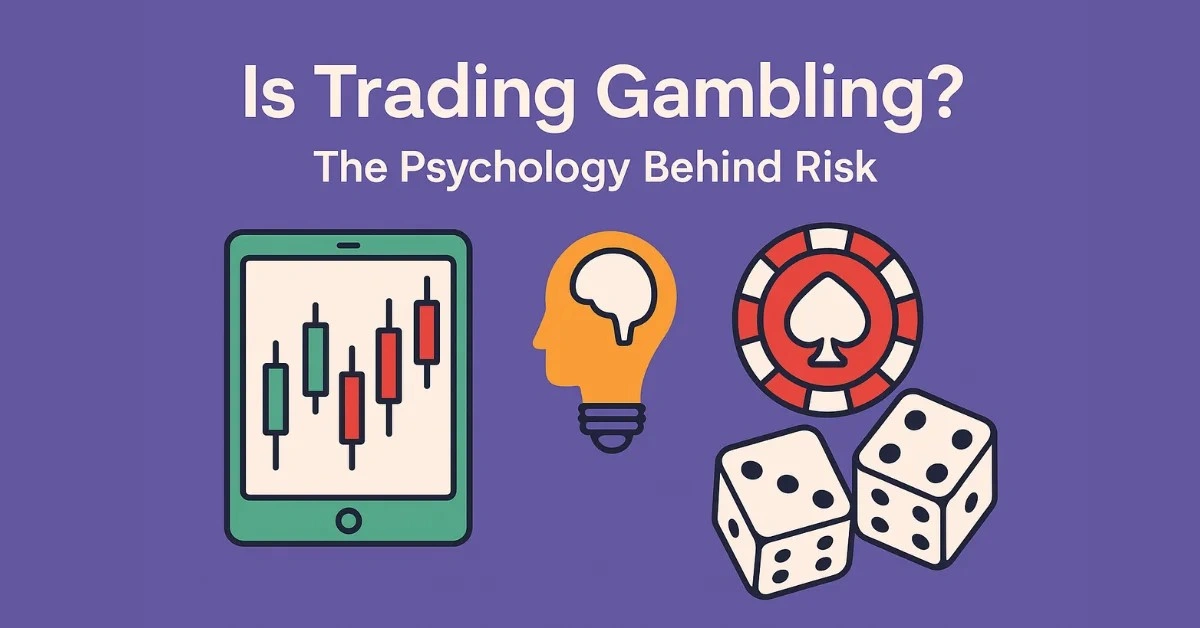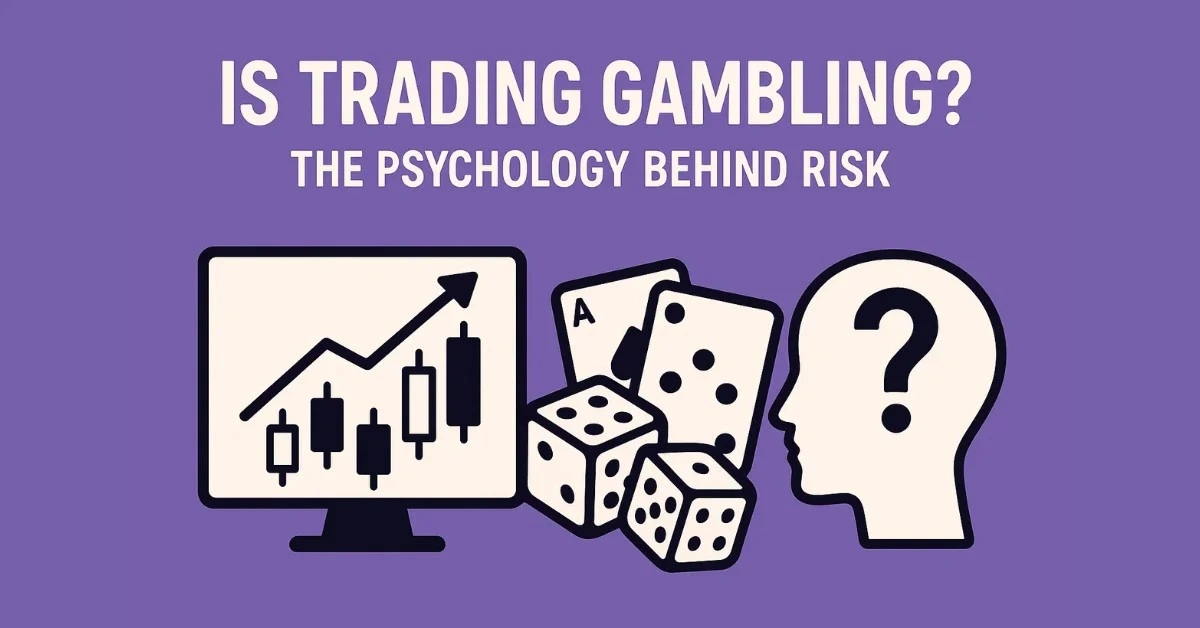

Financial markets are often misunderstood, and one of the most common questions is “is trading gambling?” Many people perceive trading as a game of chance where outcomes are unpredictable. While trading and gambling both involve risk, there are fundamental differences in mindset, preparation, and strategy. Understanding these distinctions is essential for traders, investors, and risk awareness advocates seeking to navigate markets responsibly. This guide explores risk perception, compares the gambling vs trading mindset, and provides clarity on the psychology behind risk.
Understanding Risk in Trading
Trading involves exposing capital to potential gains or losses. Unlike gambling, which often relies on luck, trading incorporates skill, analysis, and strategy to manage risk effectively.
Key components of risk in trading:
- Market Risk: Exposure to price fluctuations in the market.
- Leverage Risk: Using borrowed capital to increase trade size amplifies both gains and losses.
- Liquidity Risk: Difficulty in entering or exiting positions without affecting price.
- Psychological Risk: Emotional reactions to gains, losses, and market volatility. This aspect of risk is closely related to forex psychology, where emotional discipline plays a critical role in managing market exposure.
Proper risk management techniques allow traders to anticipate outcomes, protect capital, and make informed decisions, which separates trading from pure gambling.
What Is Gambling?
Gambling typically involves betting on outcomes with high uncertainty and little control over results. Success is primarily dependent on chance rather than skill. Examples include lotteries, slot machines, and roulette.
Characteristics of gambling:
- Outcome Unpredictability: The result is largely random.
- No Long-Term Edge: The expected return over time is negative for most gamblers.
- Emotional Decision-Making: Outcomes often evoke impulsive behavior.
- Immediate Resolution: Results are realized quickly with limited opportunity to adjust strategy.
Understanding these traits clarifies why trading, which relies on analysis and planning, differs fundamentally from gambling.
Risk Perception in Trading vs Gambling
Risk perception is how individuals interpret and respond to potential loss. Traders and gamblers approach risk differently due to preparation, control, and expected outcomes.
1. Control Over Outcome
- Trading: Traders use analysis, technical indicators, and fundamental research to guide decisions.
- Gambling: Gamblers have little or no control over the outcome.
2. Probability and Expectancy
- Trading: Traders can calculate probabilities, set stop-loss limits, and determine risk-to-reward ratios.
- Gambling: Probabilities exist but cannot be influenced, and expected returns are often negative.
3. Emotional Response to Loss
- Trading: Losses are analyzed objectively to improve future performance.
- Gambling: Losses can lead to emotional decision-making and chasing bets.
By recognizing these differences in risk perception, traders can adopt a disciplined approach and avoid the impulsivity associated with gambling, a strategy that aligns with copy trading meaning, where automatic trade mirroring allows for more calculated decisions.
Gambling vs Trading Mindset
The gambling vs trading mindset is one of the most significant distinctions between the two activities. A trader’s mindset emphasizes discipline, patience, and strategic planning, whereas gambling is driven by impulsive behavior and luck.
Trading Mindset Characteristics:
- Goal-Oriented: Trades are planned with clear objectives and risk limits.
- Analytical: Decisions rely on data, indicators, and market trends.
- Risk-Aware: Losses are expected and controlled through proper position sizing.
- Learning-Focused: Each trade is an opportunity to refine strategy.
Gambling Mindset Characteristics:
- Outcome-Oriented: Focus is on immediate wins rather than long-term results.
- Chance-Driven: Decisions rely on luck or gut feelings.
- High Emotion: Wins and losses provoke impulsive actions.
- Random Learning: Experience does not systematically improve results.
Adopting a trading mindset is essential for developing a sustainable approach to financial markets, as seen in how copy trading works, where you follow experienced traders’ actions in real-time.
Position Sizing and Risk Management
A key tool separating trading from gambling is position sizing, which determines how much capital to allocate to each trade. Proper position sizing ensures that even a losing trade does not threaten overall portfolio health.
Principles of position sizing:
- Limit risk per trade to a small percentage of total capital.
- Adjust trade size based on market volatility and stop-loss levels.
- Use consistent sizing rules across trades to maintain stability.
When traders control exposure with position sizing, they reduce the likelihood of large, emotional losses, which is also critical in what is copy trading in forex to ensure balanced risk management a factor absent in gambling.
The Role of Analysis in Trading
Traders use various forms of analysis to make informed decisions. This distinguishes trading from gambling, where outcomes are largely random.
Types of analysis include:
- Technical Analysis: Studying price charts, patterns, and indicators to predict future movements.
- Fundamental Analysis: Evaluating economic data, interest rates, and geopolitical factors to anticipate trends.
- Sentiment Analysis: Monitoring market psychology to gauge potential price movements.
Through consistent analysis, traders can increase the probability of profitable trades over time.
Common Misconceptions: Is Trading Gambling?
Despite evidence to the contrary, some people believe trading is the same as gambling. Addressing these misconceptions is essential for promoting responsible trading behavior.
Misconception 1: All trades are purely luck-based.
- Fact: Skilled traders rely on analysis, strategy, and risk control, not luck.
Misconception 2: Day trading is high-risk gambling. However, copy trading in forex helps reduce individual risk through automated copying of successful trades from experienced professionals.
- Fact: While day trading carries risk, disciplined traders use stop-losses, position sizing, and probability-based strategies to manage it.
Misconception 3: Small capital cannot succeed without luck.
- Fact: Even small accounts can grow steadily using consistent risk management and strategic trading.
By clarifying these points, traders can approach markets with realistic expectations and reduce emotional decision-making.
How to Cultivate a Trader’s Mindset
Developing the correct mindset is essential for separating trading from gambling.
Steps to cultivate a trader’s mindset:
- Set Clear Goals: Define profit targets and risk limits for each trade.
- Maintain Discipline: Follow a trading plan consistently.
- Keep a Journal: Record trades, outcomes, and reasoning for review.
- Learn Continuously: Adapt strategies based on experience and market changes.
- Manage Emotions: Avoid impulsive decisions driven by fear or greed.
A trader’s mindset emphasizes planning, analysis, and risk awareness, which are absent in gambling behavior. This is reflected in what is copytrading, where disciplined traders choose who to follow based on proven strategies.
Psychological Traps in Trading
Even with proper knowledge, traders can fall into psychological traps that make trading resemble gambling. Recognizing these behaviors is essential.
Common traps include:
- Overconfidence: Believing in infallibility after a winning streak.
- Chasing Losses: Increasing trade size to recover from losses.
- Impulse Trading: Entering trades without proper analysis or strategy.
- Confirmation Bias: Ignoring information that contradicts one’s belief.
Awareness of these pitfalls allows traders to reinforce discipline and maintain a probability-based approach.
Risk Perception and Its Impact on Performance
How traders perceive risk affects their decision-making and performance. Those who see losses as learning opportunities are more likely to succeed, whereas those who view loss as catastrophic may behave impulsively.
Key aspects of risk perception:
- Understanding that losses are part of trading.
- Calculating risk before entering a trade.
- Using objective data to inform trade size and timing.
- Remaining emotionally detached from individual outcomes.
Proper risk perception allows traders to take calculated risks rather than rely on chance.
Social Trading and Psychological Benefits
Social trading platforms for beginners offer additional psychological support by allowing users to follow and learn from experienced traders.
Benefits include:
- Reduced emotional pressure by observing professional strategies.
- Increased confidence through structured decision-making.
- Community support for education and mentorship.Social trading can reinforce the disciplined mindset necessary to view trading as a strategic activity rather than gambling. This mirrors how copy trading works, where users benefit from automatic trade execution based on expert decisions.
Social trading can reinforce the disciplined mindset necessary to view trading as a strategic activity rather than gambling.
Practical Tips for Responsible Trading
To maintain a professional approach and avoid gambling-like behavior, traders should:
- Always define risk per trade before execution.
- Use stop-loss and take-profit orders consistently.
- Avoid high-risk speculation without analysis.
- Start with small positions and gradually increase exposure.
- Review trades regularly to improve strategy.
These practices help traders stay focused on probability-based decision-making rather than chance outcomes.
Conclusion
The question “is trading gambling?” is common but often misunderstood. Trading shares some similarities with gambling, such as exposure to risk, but the core difference lies in control, strategy, and risk management. Traders use analysis, position sizing, and risk management to improve the probability of success, while gambling relies primarily on chance.
Understanding risk perception, cultivating a trading mindset, and avoiding psychological traps are key to long-term success in financial markets. Social trading platforms and educational tools can further support beginners in learning discipline, strategy, and risk awareness. By separating facts from myths, traders can approach markets with a professional mindset and sustainable strategies.