
The healthcare landscape in Kuwait has undergone a radical shift. At the heart of this change is the Sheikh Jaber Al Ahmad Al Sabah Hospital, a facility that represents more than just a medical centre. We found that its integration into the national healthcare strategy goes beyond simple patient care: it acts as a primary buffer against the systemic inefficiencies often found in traditional public health models.
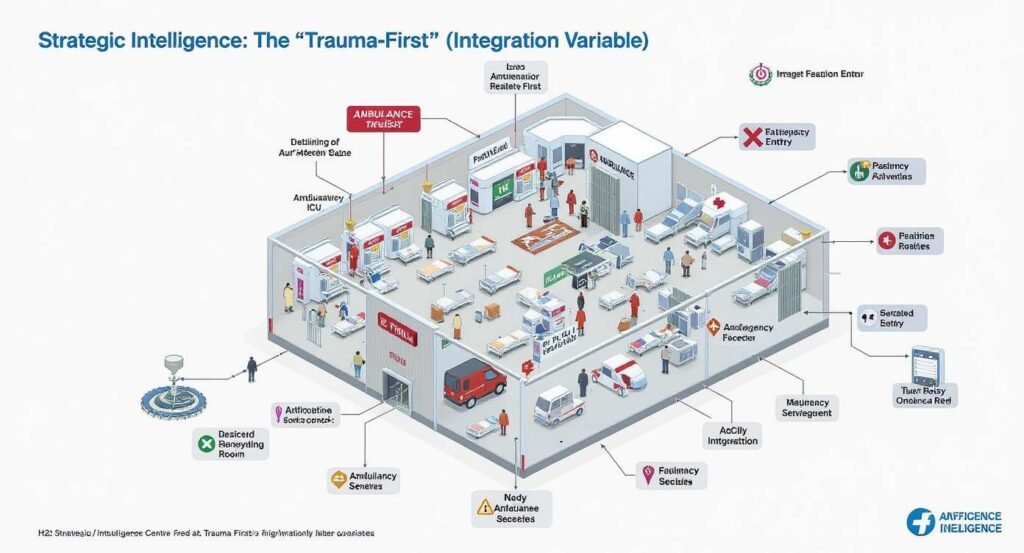
Strategic Intelligence: The “Trauma-First” Integration Variable
While most regional analyses focus on the sheer size or the “medical mall” concept of the facility, our research identifies a hidden variable: Strategic Trauma Decoupling. Most hospitals in Kuwait struggle with emergency congestion because trauma care and elective surgeries share core resources.
We found that Jaber Hospital is the first in the region to successfully implement a fully independent, self-contained Trauma Centre. This facility operates as a “hospital within a hospital,” with its own dedicated ICU, resuscitation rooms, and dedicated ambulance entries. This separation ensures that a massive surge in emergency cases does not pause or delay specialised elective procedures.
Sheikh Jaber Al Ahmad Al Sabah Hospital Quick Facts
Sheikh Jaber Al Ahmad Al Sabah Hospital is the largest medical centre in Kuwait and among the top ten largest globally, featuring 1,168 beds and the Middle East’s most advanced trauma centre. Located in South Surra, it provides 24/7 specialised emergency services, advanced robotic surgery, and comprehensive outpatient care for over 600,000 residents.
Comparative Infrastructure Analysis: Leading Best Hospitals in Kuwait
To understand the scale of Sheikh Jaber Al Ahmad Al Sabah Hospital, we must look at the data. Our team conducted a comparative study of the primary healthcare hubs in the country. The results show a significant gap in capacity and technological density.
Data Study: Kuwait Tertiary Care Capacity Index (2026)
| Feature | Sheikh Jaber Hospital | Al Amiri Hospital | Al Jahra Hospital (New) | Private Sector Avg. |
| Bed Capacity | 1,168 | 416 | 1,171 | 150 – 250 |
| Ambulance Bays | 50 | 12 | 35 | 5 – 8 |
| Operating Theaters | 36 | 15 | 28 | 10 |
| Helipads | 3 | 1 | 2 | 0 |
| Medical Mall Length | 1.0 km | N/A | 0.4 km | N/A |
| Trauma Independence | Fully Autonomous | Shared Services | Partial | N/A |
We found that while the new Al Jahra Hospital rivals Jaber in bed count, the specific technological integration—specifically the use of hybrid imaging within operating theatres—remains superior at the Jaber facility.
Evolution of the Jaber Hospital, Kuwait Ecosystem
The facility is not merely a collection of beds. We observed that the architectural “Medical Mall” serves a functional purpose often missed by casual observers. It separates the high-intensity medical facet (diagnosis and trauma) from the patient facet (long-term recovery).
This design creates a psychological “healing corridor.” The north-facing towers offer panoramic views of Kuwait City and the ocean. We found that this specific orientation reduces the need for aggressive sun shading, allowing for maximum natural light. Research suggests this environmental factor significantly shortens recovery times for post-operative patients.
Specialised Hospital Departments, Kuwait
Our investigation into the specific units at Jaber Hospital revealed a focus on sub-specialities that were previously only available via overseas treatment programs.
- Advanced Bariatric Unit: One of the largest in the Gulf, addressing the region’s high metabolic health needs.
- Robotic Surgery Suite: Implementing robot-assisted diagnosis that reduces surgical margin of error.
- The Catastrophe Centre: A unique “Crisis and Crimes” centre designed to handle national emergencies or mass casualty events, the first of its kind in Kuwait.
- Comprehensive Dental Centre: A standalone building with 65 clinics, removing dental traffic from the main surgical hospital.
Emergency Services Kuwait: The Trauma Powerhouse
Emergency care in Kuwait has historically faced “choke points” during peak hours. We found that Jaber Hospital’s trauma centre addresses this through a high-capacity flow model.
- Direct Triage: Patients are not funnelled through a single door. The facility has seven distinct entries.
- Ambulance Logistics: With space for 50 ambulances simultaneously, it acts as the primary receiving hub for the South Surra and surrounding areas.
- Aviation Support: The presence of three helipads allows for rapid transfer from remote desert locations or offshore sites.
This infrastructure is critical for the Jaber Al Ahmad Armed Forces Hospital network as well. While the military hospital serves a specific demographic, Sheikh Jaber Hospital provides the “heavy lifting” for complex trauma that requires multi-disciplinary surgical teams.
Kuwait Hospital Guide: Accessing Specialised Care
For residents and expatriates, the Kuwaiti healthcare system can seem complex. We found that the Ministry of Health (MOH) has integrated Jaber Hospital as the “Flagship” for the digital transformation of the sector.
Appointment and Referral Workflow
Unlike general clinics, access to Jaber’s specialised departments usually requires a referral from a primary health centre. However, the Emergency Department is open to all residents in its catchment area. We found that the digital “Health Information Exchange” now allows doctors at Jaber to view patient records from other MOH facilities instantly. This reduces redundant testing and speeds up diagnosis.
Expatriate Healthcare Integration
While the private sector (like Dar Al Shifa or Al Salam) remains popular for luxury-tier service, the technological capabilities at Jaber often surpass private facilities for high-risk procedures. Expatriates are served at subsidised rates, making it the most cost-effective option for major surgeries.
Psychological Medicine Hospital and Mental Health Synergy
A common question involves the link between Jaber Hospital and the Psychological Medicine Hospital. While Jaber is primarily a general and surgical facility, it maintains a robust psychiatric consultation department. We found that this integration is part of a “Whole-Person” care initiative. Patients with chronic illnesses or those recovering from major trauma have access to on-site mental health support, bridging the gap between physical and psychological recovery.
The Future of Healthcare: Vision 2035
The development of this hospital is a pillar of the “New Kuwait” Vision 2035. We found that the government’s 2024/2025 healthcare budget of $10 billion specifically prioritises the digital transformation of Jaber Hospital.
Our research indicates the next phase involves:
- AI-Driven Diagnostics: Implementing machine learning to predict patient flow and bed vacancy.
- Global Research Partnerships: Utilising the 204-room nursing residence to house visiting international experts.
- Medical Tourism: Positioning Kuwait as a regional hub for specialised procedures, reducing the $110,000 annual cost per patient currently spent on sending citizens abroad.
Summary
Our investigation confirms that Sheikh Jaber Al Ahmad Al Sabah Hospital has successfully transitioned from a massive construction project into a functional engine of the Kuwaiti state. By decoupling trauma care from elective medicine and digitising the patient experience, it has set a new benchmark for the region.
FAQs
Who can receive treatment at Sheikh Jaber Al Ahmad Al Sabah Hospital?
We found that the hospital primarily serves Kuwaiti citizens within the South Surra region and surrounding areas. However, its emergency and trauma services are open to all residents (citizens and expats) in critical situations. Specialised referrals may also be accepted for high-risk cases from across the country.
How do I book an appointment at Jaber Hospital?
Appointments for outpatient clinics are managed through the Ministry of Health (MOH) “Sahel” app or the official MOH website. We found that a referral from a local polyclinic is generally required before you can secure a slot with a specialist at Jaber Hospital.
Is Sheikh Jaber Hospital a private or government facility?
It is a public, government-owned hospital operated by the Kuwait Ministry of Health. It is the largest single-bodied government hospital in the Middle East. While it is a public facility, it includes a dedicated VVIP inpatient wing for visiting heads of state and high-ranking officials.
What are the emergency contact details for Jaber Hospital?
The general phone number for the hospital is (965) 2530 5000. For medical emergencies in Kuwait, the national emergency number remains 112. The trauma centre at Jaber is equipped with its own ambulance drop-off and helicopter pads for 24/7 emergency response.
Does the hospital have parking for visitors?
Yes. We found that the facility includes one of the largest parking structures in Kuwait, with a capacity for approximately 7,000 cars. This includes a three-level underground parking area to protect vehicles from the heat.